Friday, January 30, 2009

A refugee would like to have your problems


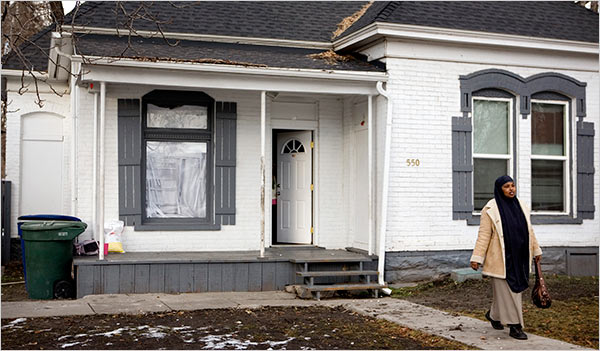
That's something my sister Linda, who has worked all her life with refugees and immigrants, always says, when either of us complains about our lot in life. This story in the New York Times about the impact of the "recession" on recent refugee arrivals really drove that home today.
Yesterday, a colleague in the refugee program at the state health department explained how the US State Department has slowed the flow of refugees into Minnesota to a trickle, by insisting that most of them be DNA-tested to prove that they are, in fact, related to some earlier refugee who is alleging to be a family member and a willing sponsor. Given the state of the economy and the likely grimness of their potential new life, maybe this is one instance in which life in a refugee camp, while not better than life in a US housing project or tenement, may not look all that bad.

Monday, January 5, 2009

Teaching Public Health


Yesterday was Memorial Sunday at church, in which the service focuses on people who have died in the past year. (We do a separate service for veterans near Memorial Day). After music and meditation, people line up in the front of the sanctuary to light a candle and say the name of a person they want to remember and want others to think about.

I thought Jim Rothenberger, who died less than a month ago, after almost dying so many times and after living so hard in the periods between his episodes of almost dying. Jim had multiple kidney transplants--the first among the earliest ever in Minnesota--and for as long as I knew him he had that moon-faced, ruddy look of someone on immune suppressants and steroids. He was sick a lot and you might know it from looking at him, but you'd never have known it from his work and travel schedule, which would have exhausted a far healthier man.

I first encountered Jim in 1986, when I signed up for the entry level course in Community Health that's required of all Education majors at the U, and recommended for those (like me), who were contemplating enrolling in a masters' program in public health. I'd settled in to a seat among the 300 or so in the auditorium, expecting yet another dreary lecture-cum-slide show from some teaching assistant. Instead Jim walked in and perched on a high stool, launching into the first of a seemingly extemporaneous series of stories about the sex and drug habits of first year university students; what they were, and how to alter them. He was hilarious, relevant and vastly well-informed, and he had me at "sex and drugs."

Jim was a true teacher in the land of academics, spurned by the establishment of the U because he merely had a masters' degree and had never bothered with the PhD, but awarded nearly every teaching honor he could have won for community service, faculty recognition, and creative teaching. He taught me that to engage people in thinking about public health, all one had to do was to talk about the day's headlines, and that to do something about public health, all one had to do was to act boldly.

He did something alright, at least in in my case, recruiting me to help him create the University's first course on HIV-AIDS, in 1987. This was back in the day when people weren't so sure you couldn't "catch" HIV infection from swimming in a pool or being bitten by a mosquito. The course, an overview designed to both educate and reassure, led the way for more specialized, technical instruction in the schools of medicine and nursing, and was a first salvo in the School of Public Health's slow turning from an almost exclusive focus on tobacco, nutrition and heart disease to a more encompassing roster of issues in infectious as well as chronic disease.

I mostly lost touch with Jim after I finished my masters' degree, but I would see him around every once in a while, and he always greeted me like a long-lost colleague, telling me the latest School gossip and joking about his apparent lack of status. Despite what I learned from Jim, I never felt like a mere student in his presence; his gift was to take people seriously while laughing at life's frequent silliness. He taught me how to teach public health and how to maintain a healthy disrespect for the status quo, both lessons I am grateful to have learned. Although I didn't light a candle for Jim on Sunday, his memorial service is still to come, and the candle I swiped from the basket after my church service will be lit then, in his honor.

Saturday, September 20, 2008

Diversity Rx


It's the name of an organization I've been working with lately, but also (cleverly) a shorthand reminder of what's needed to make the US health care system a bit less confusing, alarming, and downright harmful to the folks from other countries who wash up in here in the land of the "best health care in the world" Some diversity: of perspectives, of primary languages, of outlooks in life and death and health—all are needed. Too bad they can't be prescribed.

Or maybe they can. For the next few days, attendees at a big conference in Minneapolis sponsored by Diversity Rx (and others) will have a chance to weigh in on what's needed to make health care here more "culturally competent"--that is more sensitive to important race, class, language and cultural and even biological differences among people. More info on the conference here.

I'll be reporting on what's new and exciting at the conference, from a cat-bird seat as it turns out, since I'll be coordinating a massive group conversation session in which 500 attendees will be asked to talk with one another—and to report back to us all—on how to actually achieve "Diversity Rx." Stay tuned.

Monday, April 21, 2008

I'll be at the Global Health Council Conference

(From the conference program for the Global Health Council's annual conference, which takes place May 27-31 in Washington, DC More info at the Council's website, www.globalhealth.org.)

Brown-Bag Session: Finding Work in Global Health
Friday, May 30, 2008
12:45-1:45 pm
Capitol Room

Considering a global health career, a part-time internship, or simply a volunteer stint overseas? You won't want to miss this brown-bag workshop. Patricia Ohmans, MPH, co-author of the book Finding Work in Global Health, will offer an insider’s guide to entering the field. Her lively, interactive presentation will cover the 10 top myths about global health; seven ways to work in the field; a dozen questions to ask yourself BEFORE you go, and more. This session is designed especially for entry-level professionals, but NGO recruiters are cordially invited to participate.

In Praise of Plumbing

Tony’s mother Dolores Pink, who was born in 1925, used to say that the greatest invention she experienced in her lifetime was the installation of indoor plumbing in her family’s home in Shakopee, Minnesota.

After nearly nine months of our sabbatical in Bolivia, we know whereof she spoke. We’ve become major fans of toilet paper, a sink with running water, flush toilets, and hand soap, none of which are a given in Bolivian bathrooms, even those in otherwise hygenic settings, like a middle class restaurant, the US-style grocery store, or a landscaped gas station.

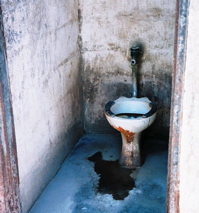
It appears that in Bolivia, nobody wants to think about shit, literally. Last week, I visited a squatter’s settlement in which a German foundation has spent millions of euros in the past five years building a lovely nursery school and day care center, a primary school, a high school, athletic fields, a medical clinic and a dental office. The school bathroom was, as usual, awash in spilled water and unflushed toilet paper. If it had been flushed, it would have gone...pretty much nowhere, as the settlement is built on granite-hard soil.

The community had some paved roads, pipes laid for the running water that was coming soon, and they were getting electricity that weekend. When I asked about sewerage pipes, the foundation’s operating manager, a lovely and intelligent young woman, looked amused. “Maybe in 2010,” she mused, half to herself. Where do individuals in this community of 5,000 souls relieve themselves? “Down there,” she said, waving vaguely at an alley we were passing. “Behind their houses. Up in the hills somewhere.”

It’s just as much of a problem downtown, where the few public baños charge users a boliviano for the privilege (and a couple squares of pink papel higenico.) I’ve seen little children pooping on newspaper and throwing it in a sidewalk dumpster, and older women squatting at the curb, skirts hitched up.

I’ve done the equivalent on long bus rides, when the driver stops at a stretch of roadside and everyone gets out and wanders off in what they hope will be an invisible direction. It’s a rare Bolivian bus whose bathroom is unlocked, and if you ask the driver’s assistant to unlock it he may do so, but only after warning you sternly to “solamente orinar!” Hard orders to follow, at times.

I brought a suitcase full of books down with me to Cochabamba, but the only book that I’ve read more than once is a slim manual called Sanitation and Cleanliness for a Healthy Environment, published by the Hesperian Foundation, the folks that produce Where There Is No Doctor. It’s got chapter headings like “Diarrhea and Dehydration,” ; “2-Pit Compost Toilet” and “Pour-flush Pit Toilet”. Increasingly, that book looks like a how-to for healthier life in Bolivia. I keep it in our bathroom.

Monday, March 31, 2008

My doctor, my torturer

Would your doctor knowingly participate in torture? Jokes about colonoscopies aside, of course not, right? Well...maybe not, at least not if said doctor is present at an interrogation.

Last year, researchers at Harvard asked nearly 2,000 medical students how much they know about medical ethics in military situations, specifically, on the ethical obligations of doctors and nurses when prisoners of war are being interrogated.

The students were asked if a physician would be ethically obligated to refuse an order to participate in an interrogation by 1) threatening to inject the prisoner with a psychoactive drug, 2) injecting the prisoner with a harmless solution which the prisoner believes to be lethal, or 3) actually injecting the prisoner with a lethal drug.

Although all three scenarios would be prohibited under the Geneva Conventions, one in three of the students thought that the only circumstance in which they would be ethically required to disobey was when they might cause the death of the prisoner. In any case, more than 100 of the respondents said they would, if ordered, kill the prisoner by injection.

The Geneva Conventions--universally accepted since their promulgation in the wake of Nazi doctors involvement in the Holocaust--ban threatening, coercing, humiliating, degrading, or injuring prisoners of war for any reason, not to mention murdering them. But according to the Bush administration these widely accepted principles don't apply to prisoners we're holding at Iraq-war related prisons such as Abu Ghraib or Guantanamo.

If you want to read the whole medical students study, it was published in the International Journal of Health Services, Volume 37, Number 4, and is available online. For more on the subject of medical complicity in torture, try Minnesota doctor Steve Miles' book, Oath Betrayed: Torture, Medical Complicity and the War on Terror. available on Amazon.

Tuesday, March 25, 2008

The Picture on the Pack


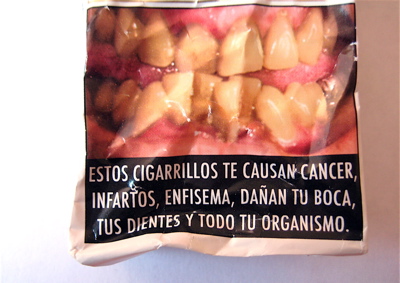
I just got back from a week's trip to northern Chile; mostly a vacation, but also a chance to see what Chileans are doing about the country's smoking problem. Suffice to say, it's more than we do in the US.

The picture above shows what every smoker in Chile has to look at when he or she pulls out some smokes: a gruesome close-up of a set of snaggled, stained teeth set in some funky gums, all of them ruined by tobacco. Apparently, a two-year old Chilean law mandates that half the space on a pack must carry anti-smoking messages specified by the government. Packs used to feature a grim, explicit photo of a Chilean smoker who lost his larynx to cancer; he has since died.

The consistent warning message on the pack, a masterpiece of blunt health education, reads: “ The smoke of each cigarette you smoke contains, along with other toxic products: tar, which causes cancer; nicotine, which makes you addicted; carbon monoxide, a toxic gas like that from tailpipes; and arsenic, a chemical used as rat poison.”

And yet, Chile has the highest tobacco consumption in all of South America. 40% of the general population smokes, as do 45% of women of childbearing age; thanks to vigorous efforts by the tobacco industry’s advertisers, this is the highest smoking rate among women in the world.

It’s not something the government health folks are ignoring, obviously; the health education campaign is accompanied by laws firmly restricting cigarette advertizing in media, creating no-smoking zones in restaurants and bars; and banning ads and sales within a certain distance of schools. It's good public health--social marketing and social engineering. But given the number of young kids—maybe 12, 13 years old— we saw in Arica wielding that ugly-looking pack and puffing away, the messages may have to cover the whole box before they truly get people’s attention.